17 September 2007

Heidegger's muse


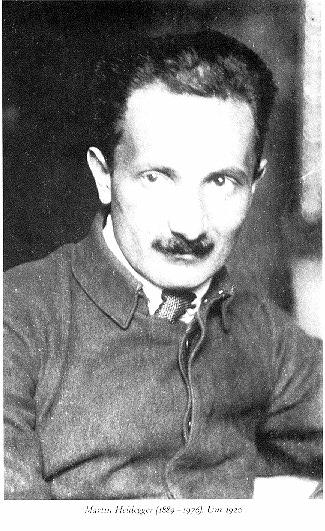
Heidegger dares to think the 'unthought' in other thinkers. But at the same time he points out that the more original a thinker's thought, more the unthought in him, the more he fails to comes to grips with what he thinks. Heidegger's thought, in this sense, may be termed un-original - it does not allow itself to leap into the fertile patch of obscurity. His thought abandons a certain kind of unreflective innocence - it is almost too serious, too morose, too self-absorbed, too proud. And for this very same reason, his philosophy opts the path of safety; it always makes a safe bet, because it first wants to secure for itself the second best place from which it then hopes to aim for the stars (if it can hope at all).

But this passivity is also the 'woman' in Heidegger's thought, which says, "I cannot love but I want to be loved." The latter, more than anything. This 'woman' refuses to be tied down, almost to the point of being promiscuous. She jumps from one nook to another, eternally afraid of being 'pinned down', since to settle is to enter the very unthinking-domain of creative obscurity. She bails herself out of every situation that might define and limit her. (Why? Because she has already limited herself in a deeper sense?) She washes her hands off the risks of existence. She wants to be free, out of irresponsibility.

Limbo

The mere thinkability of a thought is not a proof of its truth. Nevertheless, this very thinkability makes the thought irrefutable. So it is with the vestibule we call life - irrefutable, but not yet true.

31 August 2007

Our venue


What a curious phenomenon it is to see the living ones scavenge the remains of the dead! Waiting for our geniuses, writers, and leaders to die, we excavate our spoils, not sparing their secret diaries, intimate details, drafts and undelivered performances. How much we do not believe in an after-life! We gossip about them, slander them, appraise them, especially since our voice was choked when the "voice of our generation" was still alive and speaking. And all in the name of respect for our heroes - bad manners with a clear conscience! Like the vulture which prefers to have a bald head, devoid of feathers, to avoid spattering of blood as it feeds on its dead carcass - we prefer to be ugly than have a bad conscience! We live only as spies, and hence inspite of our lack of right to do so.

26 August 2007

Violence of philosophy

Nietzsche achieves the thorough-going self-contradictory nature of his thought - by means of which he earns, in truth, his right to criticize philosophy, and criticize it inexhaustively - by means of compromising the innocence of his reader. This compromise appears as Nietzsche's unpleasant need for self-criticism, that is, his need to retract instinctively what the uncritical forward impulse of his life puts forward. Why? : In search of an innocence not condemned to forceful retraction.

23 August 2007

Sur Bataille

The prodigal submits his work to the world and remains silent, as he has to be. What that work is, Who the author really is -- regarding these the genius keeps silent and lets the course of things take its toll. And this out of modesty, out of abundance, out of style. -- General Economy

The average great man (ex: a scholar) imposes his work onto the world, and proceeds to "clarify" it or himself. He speaks where he has to keep quiet. He always feels that he has inadequately expressed himself in his work. (Consider the feminists interpreting Nietzsche: "Nietzsche is wrong here. Not ALL feminists imitate men... look at us!"). He says he started to compose after his inspiration already had whizzed passed him. He says he is too profound even for himself! His clumsy footnotes are more important than the main body of his work. He has a rejoinder for everything -- he mistrusts the imagination of his reader. Hence the scholar, the laborer, the working class. He hides behind the purdah and chooses to remain silent when he ought to speak. -- Restricted Economy

Tab